The "Belt and Road Initiative" is the abbreviation of the "Silk Road Economic Belt". The "Belt and Road Initiative" has multiple positive impacts on economic development. From a trade perspective, the initiative has promoted trade exchanges among the countries along the route. By strengthening infrastructure construction, such as ports, railways, and highways, it has reduced trade costs and improved trade efficiency. At the same time, eliminating trade barriers and promoting trade liberalization and facilitation have enabled the smooth circulation of goods and services among countries.
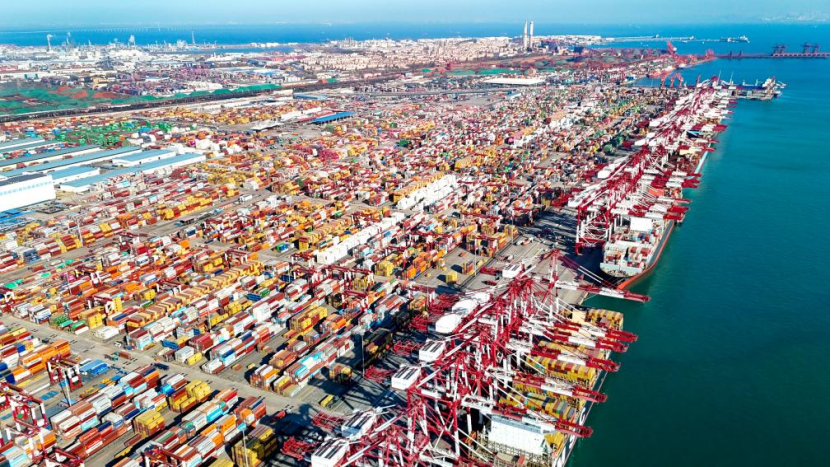
In recent years, the advantages of the "four port" linkage in Qingdao have been continuously strengthened. It has been approved to build an international comprehensive transportation hub city. An open new pattern of mutual benefit between the east and west and integration of land and sea has been acceleratingly formed. Qingdao Port has cumulatively opened 42 routes to the countries participating in the "Belt and Road Initiative", with a total of nearly 200 container routes. Qingdao has cumulatively operated over 2,900 China-Europe freight trains, with 31 regular routes, reaching 23 countries and 54 cities participating in the "Belt and Road Initiative". It has 73 sea-rail intermodal train lines, operating short shuttle train lines connecting the Qingdao Central Station of China Railway Container Group to the Qiongbay Port Area, innovatively creating a "front port-back station, integrated operation" sea-rail intermodal service model, and gradually building a "point-line-area" multi-dimensional development sea-rail intermodal new pattern. The total number of international air freight routes of Qingdao International Airport has reached 14, basically covering the important air hub nodes along the "Belt and Road" in China.
According to statistics from Qingdao Customs, in the first 11 months of this year (2025), the import and export volume of Qingdao was 826.98 billion yuan, accounting for 25.9% of the total import and export value of Shandong Province. Among them, the import and export to the countries participating in the "Belt and Road Initiative" was 495.79 billion yuan, increasing by 5.1%, accounting for the first time reaching 60% of Qingdao's overall foreign trade, an increase of 3.6 percentage points compared to the end of last year.
List of countries participating in the Belt and Road Initiative:
The Asian countries under the Belt and Road Initiative (41):
Afghanistan, United Arab Emirates, Oman, Azerbaijan, Pakistan, Palestine, Bahrain, East Timor, Philippines, Georgia, Kazakhstan, South Korea, Kyrgyzstan, Cambodia, Qatar, Kuwait, Laos, Lebanon, Maldives, Malaysia, Mongolia, Bangladesh, Myanmar, Nepal, Saudi Arabia, Sri Lanka, Tajikistan, Thailand, Turkey, Turkmenistan, Brunei, Uzbekistan, Singapore, Syria, Armenia, Yemen, Iraq, Iran, Indonesia, Jordan, Vietnam
African countries under the Belt and Road Initiative (52):
Algeria, Egypt, Ethiopia, Angola, Benin, Botswana, Burkina Faso, Burundi, Equatorial Guinea, Togo, Eritrea, Cape Verde, Gambia, Congo (Brazzaville), Congo (Kinshasa), Djibouti, Guinea, Guinea-Bissau, Ghana, Gabon, Zimbabwe, Cameroon, Comoros, Côte d'Ivoire, Kenya, Lesotho, Liberia, Libya, Rwanda, Madagascar, Malawi, Mali, Mauritania, Morocco, Mozambique, Namibia, South Africa, South Sudan, Niger, Nigeria, Sierra Leone, Senegal, Sao Tome and Principe, Sudan, Somalia, Tanzania, Tunisia, Uganda, Zambia, Chad, Central Africa
European countries participating in the Belt and Road Initiative (27):
Albania, Estonia, Austria, Belarus, Bulgaria, North Macedonia, Bosnia and Herzegovina, Poland, Russia, Montenegro, Czech Republic, Croatia, Latvia, Lithuania, Luxembourg, Romania, Malta, Moldova, Portugal, Serbia, Cyprus, Slovakia, Slovenia, Ukraine, Greece, Hungary, Italy
The North American countries under the Belt and Road Initiative (13):
Antigua and Barbuda, Barbados, Panama, Dominican Republic, Dominica, Grenada, Costa Rica, Cuba, Honduras, Nicaragua, El Salvador, Trinidad and Tobago, Jamaica
The South American countries under the Belt and Road Initiative (11):
Argentina, Brazil, Peru, Bolivia, Ecuador, Colombia, Guyana, Suriname, Venezuela, Uruguay, Chile
The Oceania countries under the Belt and Road Initiative (12):
Papua New Guinea, Fiji, Kiribati, Cook Islands, Micronesia Federation, Nauru, Niue, Samoa, Solomon Islands, Tonga, Vanuatu, New Zealand